
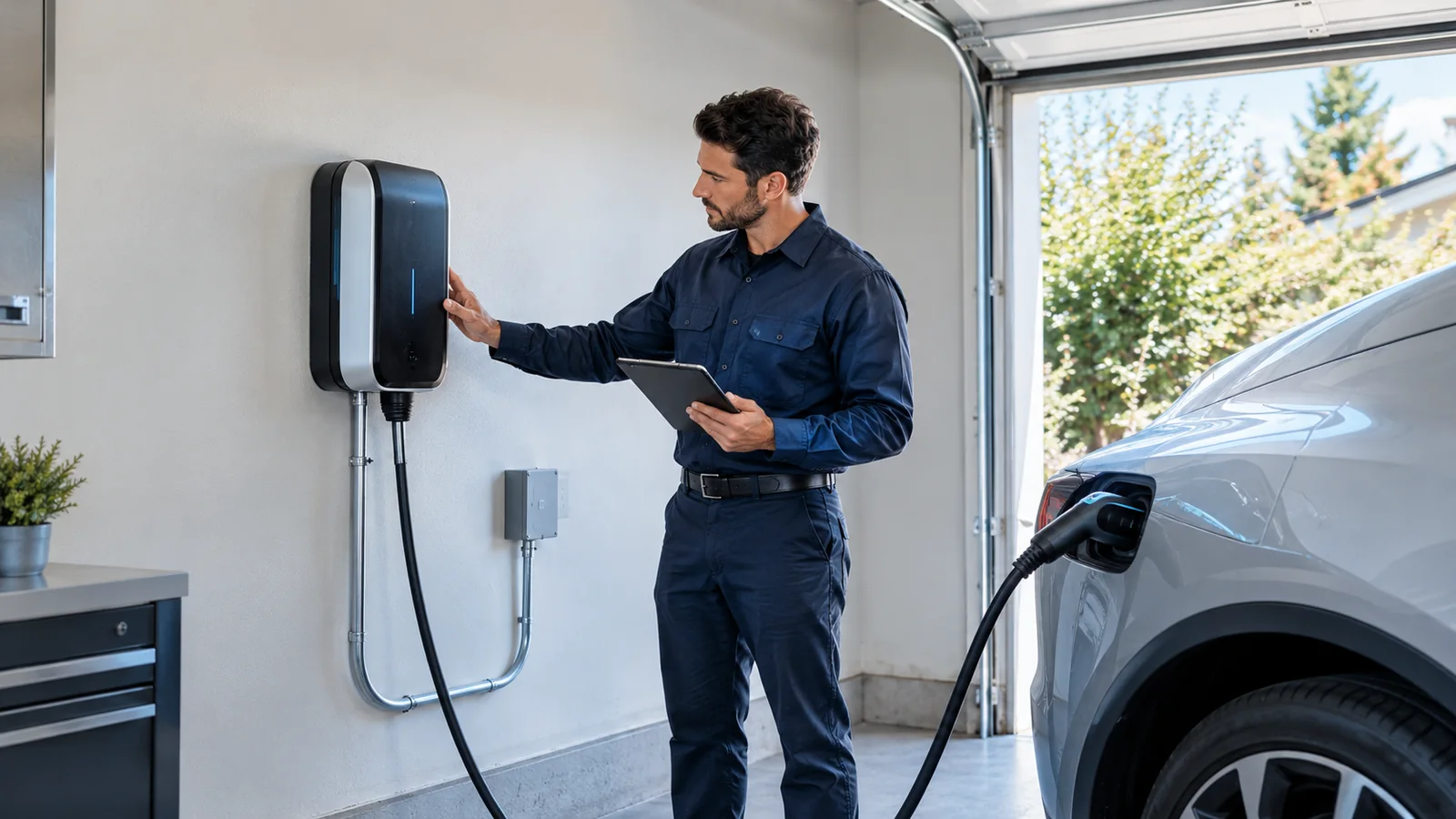
What ev charger installation can involve
EV charger installation means fitting and connecting charging equipment so an electric vehicle can recharge at a property. For many homes, a Level 2 charger provides faster charging than a standard household receptacle, but it requires a correctly designed circuit and compatible equipment. A hardwired unit and a plug-in unit may have different installation details and should be selected for the home and vehicle.
For EV charger installation in Santa Ana, begin with where the vehicle is parked, how the cable will reach the charging port, the charging rate you actually need, and whether the panel can support the additional load. Our Santa Ana electrical service guide also covers panel upgrades and other electrical projects that may interact with the charging plan.
Planning a Level 2 home EV charging station
An electric car charger for home use may be a portable cordset, a plug-in Level 2 EV charger or a hardwired charging unit. Level 2 equipment commonly uses a 240-volt supply and can charge faster than basic Level 1 charging, but the actual result depends on the vehicle, charger output, available electrical service and daily driving pattern. Choose the charging rate you need instead of assuming the highest-rated unit is automatically the best fit.
Before purchasing a home car charging station, note where the vehicle parks, whether it is indoors or outdoors, the cable route, connector compatibility and any scheduling or load-management features you want. The existing panel, available circuit capacity, route length, wall construction and distance to the parking space can affect the installation scope. A provider may recommend assessing capacity or an electrical panel upgrade before the charger is selected.
EV charger installation cost varies with the charger, wiring route, circuit and panel work, mounting location, permit requirements and any trenching or surface repair. A clear quote should identify what equipment is included, whether the unit is hardwired or plug-in, the planned circuit, permits and final checks. Avoid relying on a single generic price or on the assumption that every home supports every Level 2 unit. For an official overview of charging options and home equipment, see the U.S. Department of Energy's Alternative Fuels Data Center guide for electric-vehicle consumers.
If charging needs appear to exceed the home's present capacity, explain the expected usage and other major electrical loads before authorizing work. The goal is a compatible home charging setup—not just a charger installed on a wall.
How the work is typically assessed
The electrician reviews the panel rating, existing loads, circuit availability, and the charger specifications. The planned circuit is based on charger current, wiring method, conductor size, overcurrent protection, temperature and installation conditions. A load calculation may determine that the home can support the charger as proposed or that load management, a lower charging setting, or service work should be considered.
The route from the panel to the parking area influences the project. A garage installation may require a shorter conduit route than a detached garage, carport, driveway pedestal or outdoor wall. The design should account for physical protection, cable reach, weather exposure, vehicle movement, mounting height and access without creating a trip hazard or leaving the charging cable stretched across a walking path.
Before installation, confirm charger compatibility, networking or smart features if desired, the mounting surface, and whether the equipment is hardwired or uses an approved receptacle arrangement. Ask who will provide the charger, which electrical parts are included, whether permits and inspection are included, and whether the work supports future expansion. Do not assume a larger charger will make charging faster if the vehicle or service cannot use the extra capacity.
Eight warning signs and what they may mean
Do not use a damaged charging connector, frayed cord, scorched outlet or equipment that becomes unusually hot. Avoid extension-cord workarounds for EV charging and have the charging equipment and supply circuit checked if damage or repeated interruptions appear.
- Charging takes too long: A Level 1 charging setup may not replenish the daily mileage needed by a household. Review driving patterns and the vehicle’s onboard charging rate before choosing hardware.
- New EV or plug-in hybrid purchased: A second vehicle or a new daily commute can change charging requirements and parking routines, making a dedicated home setup worth evaluating.
- No suitable parking-side circuit: The parking location may be far from the panel or lack a suitable circuit; use a design assessment rather than extension cords.
- Breaker trips during charging: A trip or charger fault code may involve circuit capacity, a connection, equipment fault or vehicle issue. Stop charging if the system behaves abnormally.
- Connector or cable damage: A cracked connector, exposed conductor, melted plastic or damaged charging cable should not be used. Follow the manufacturer’s guidance and arrange inspection.
- Outdoor mounting is exposed: Rain exposure, physical impact, sunlight, driveways and vehicle clearance affect equipment rating and placement; outdoor suitability must be checked.
- Panel capacity is unclear: A panel with open spaces is not proof that it has capacity for a continuous EV charging load. A load review determines the options.
- Multiple EVs are planned: Two chargers or future charging needs may be handled by load sharing or a broader service plan; capacity should be considered before buying hardware.
What can cause these problems?
Charging time depends on several components working together: the charger’s output, the vehicle’s onboard charger, the circuit available to the equipment, and charging settings. Buying a high-output unit does not ensure that a vehicle can accept that rate, and electrical service limits may require a different charging strategy.
Installations can become complicated because the charger is far from the panel, the route passes finished walls, a driveway needs a pedestal, or the mounting location is exposed to water or impact. Conduit, trenching, wall repair, and routing around other utilities may add scope. The actual route should be surveyed before the estimate is finalized.
Capacity questions are not resolved by counting unused breaker slots. EV charging is a sustained electrical load, so the design must consider existing demand, the intended charging current, and available service. A load-management system or adjusted charger setting may be a practical alternative to a panel replacement, depending on the equipment and calculated load.
What you can check safely before the visit
Note your vehicle make and model, its maximum AC charging rate if known, typical daily mileage, parking location, and whether you prefer hardwired equipment or a plug-in charger. This information helps distinguish a basic charging need from a higher-capacity setup.
Check the manufacturer’s documentation for the charger’s supported circuit, indoor/outdoor rating, mounting requirements and cable length. Decide where the vehicle usually parks and whether the cable can reach without passing through a doorway or crossing a walkway.
Do not install a larger breaker, repurpose an existing receptacle, use an extension cord as permanent charging infrastructure, or open the electrical panel. If charging causes repeated trips, stop using the charger until the equipment and circuit have been assessed.
A practical step-by-step service process
A charger assessment usually reviews the vehicle and charging level, proposed mounting location, electrical panel, cable route and expected daily use. Ask whether load management or a panel change is needed and request the reason for any recommended upgrade.
- Confirm the charging goal. Discuss vehicle limits, daily mileage, charging window, likely future vehicles, and whether smart scheduling or load sharing is useful.
- Review panel and route. The provider evaluates capacity, dedicated-circuit requirements, wiring route, installation surface, weather exposure, and parking/cable reach.
- Choose equipment and scope. Confirm charger model, amperage setting, hardwired or receptacle design, included conduit and cable, permit/inspection work, and any panel modifications.
- Install and demonstrate. After installation and required checks, the provider should explain charging settings, indicator lights, safe cable storage, troubleshooting and maintenance instructions.
Cost factors to ask about
EV charging installation cost is shaped by the circuit and route as much as by the charger itself. Compare the price of equipment and installation together, and ask whether capacity improvements, trenching or wall restoration are included.
| Cost factor | What to clarify |
|---|---|
| Charger hardware | Brand, output, smart controls, cable length, connectivity and outdoor-rated features change the equipment price. |
| Circuit and panel work | Breaker, conductor size, panel compatibility, load management or a panel/service adjustment influence materials and labor. |
| Route length and method | Conduit distance, attic or crawlspace access, finished-wall drilling, trenching and a detached garage can add work. |
| Mounting location | Wall mounting, pedestal installation, bollards or added vehicle-impact protection change the design. |
| Permits and finishing | Permit and inspection fees, drywall repair, paint, charger commissioning and Wi-Fi setup should be stated clearly. |
EV-charger installation costs depend on the charger, circuit length, panel capacity, routing through walls or outdoors, trenching, load-management hardware and any permit requirements. A property visit or detailed assessment helps distinguish a straightforward installation from a larger electrical project.
When to treat the situation as urgent
A charger or cable that is hot beyond normal operating warmth, melted, sparking, smoking, or physically damaged should not be used. Stop charging without touching exposed or damaged parts and seek urgent qualified guidance; move away and contact emergency services if there is smoke, fire, or immediate danger.
Most charger installations are planned projects. If a breaker trips while charging, do not repeatedly reset it or raise its rating. The cause may involve the charger, wiring, protection, vehicle, or actual load; a professional assessment is safer than changing settings by trial and error.
Planning this work in Santa Ana
In Santa Ana, an EV charging plan may differ between an attached garage, carport, driveway, detached garage, apartment parking area, or commercial lot. Ownership and parking rights can affect where equipment can be mounted and who may approve wiring in shared spaces. Establish the permitted parking location before paying for a charger or route design.
If the charger is part of a home electrification project, consider it with other planned electric loads. A panel-capacity review may help coordinate an EV charger with a heat pump, electric range, or future generator connection. For multi-unit or business settings, specify the number of charging ports, likely simultaneous demand and any access-control needs.
Before comparing bids, decide the parking spot, approximate cable reach, desired charging rate and whether smart scheduling matters. Ask for a written scope identifying charger hardware, circuit rating, route, protection, permits, panel work, testing and any work required to restore finished surfaces.
The same service question can arise in different parts of Santa Ana for different property-specific reasons. For neighborhood context, read the local planning notes for Wilshire Square and Downtown Santa Ana. These guides help you prepare a clearer request; the provider still needs to confirm coverage and assess the actual property.